
PNB vs DPNB: A Head-to-Head Decision Guide for Coatings and Cleaning
PROPYLENE GLYCOL BUTYL ETHER (PNB) and DI(PROPYLENE GLYCOL) BUTYL ETHER (DPNB) are both pure solvents and both belong to the propylene glycol butyl ether family, so a product list alone will not tell you which one belongs in your formulation. This head-to-head guide compares them on the four things that actually decide a coatings or cleaning specification: documented application scope, compliance documentation, packaging and handling, and supplier capability.
Short answer. PNB (CAS 15821-83-7) is documented for coatings and inks, cleaning agents and degreasers, and the electronics and semiconductor industry. DPNB (CAS 35884-42-5) is positioned for high-performance coatings and inks, precision cleaning and degreasing, and specialty chemicals. Coatings, inks and general industrial degreasing normally start their evaluation with PNB; precision cleaning and high-performance coating and ink systems normally start with DPNB. Packaging also differs: PNB is supplied in 180 kg carbon steel drums, DPNB in 190 kg carbon steel drums.
Why the PNB vs DPNB Decision Stalls at the Evaluation Stage
Most buyers do not arrive at this comparison empty-handed. They arrive with an application already defined — a water-based coating being reformulated, a cleaning line being requalified, or a second source being added behind an existing one. What is missing is not general solvent knowledge; it is a way to compare two products that share a family name and are often described with the same generic vocabulary.
Three failure patterns show up repeatedly during evaluation.
- Inherited specifications. The grade was set years ago in a legacy formulation, and no one has re-tested whether the other grade still fits. The specification is treated as a fixed input rather than a decision that can be revisited.
- The “stronger solvent” assumption. Buyers assume DPNB is automatically the higher-performance option and PNB the economical one, without checking which applications each product is actually documented for. This assumption is not supported by the product scope of either grade.
- Documentation treated as an afterthought. Safety Data Sheet and regulatory paperwork is requested only after the grade and the supplier have been locked, which is where EU-bound industrial programmes typically lose time.
The cost of choosing badly is measurable but usually indirect: reformulation and requalification work, cleaning performance that does not meet the acceptance criteria the line was built around, and customs or customer audits that stall because the compliance file does not match the grade on the drum. At the evaluation stage, the cheapest route is the one with the fewest unresolved unknowns — which is why application scope and documentation should be checked before price is negotiated, not after.
Industry Background: What the Propylene Glycol Ether Market Looks Like in 2024–2034
Demand for propylene glycol ethers is growing steadily rather than explosively, and that shape matters for how buyers should plan a PNB or DPNB qualification. According to Fact.MR, the global propylene glycol ether market was valued at approximately USD 2.03 billion in 2024 and is projected to reach USD 2.75 billion by 2034. Within that same outlook, China’s market for propylene glycol ether is forecast to reach a valuation of USD 606.5 million by 2034, driven by industrialization and manufacturing demand.
For the PnB segment specifically, Orion Market Reports expects an annual average CAGR of about 2% during the 2024–2031 forecast period. That figure should be read with one caveat: Fact.MR estimates roughly 3.1% growth for the broader propylene glycol ether market, so the two numbers measure different scopes rather than contradicting each other. A buyer building a multi-year supply plan should treat both as evidence of steady, manufacturing-led expansion.
The application pull behind that growth is concentrated in exactly the two areas this guide addresses. Propylene Glycol n-Butyl Ether is widely used in high-performance water-based coatings because of its solvency and coalescing properties, which help formulators meet low-VOC standards. In cleaning, PnB is preferred in electronics and precision cleaning because it provides residue-free drying and high solvency for greases. On the regulatory side, propylene glycol butyl ether used in synthesis and industrial applications in European markets must comply with REACH (EC No. 1907/2006) — a requirement that applies to the substance, not to a particular supplier’s marketing position.
For an evaluation-stage buyer, the practical implication is simple: availability is not the constraint. Grade fit, documentation and supply reliability are what determine whether a PNB or DPNB programme runs without interruption.
PNB and DPNB Head-to-Head: What Each Solvent Is Documented to Do
Neither grade is a general-purpose replacement for the other. The comparison below uses the documented product scope of each solvent rather than assumed performance rankings.
PNB — PROPYLENE GLYCOL BUTYL ETHER (CAS 15821-83-7)
PNB is a pure PNB solvent supplied in carbon steel drums at 180 kg per drum (180 L steel drum). Its documented application scope covers four areas:
- Coatings and inks.
- Cleaning agents and degreasers.
- Electronics and semiconductor industry.
- Other industrial applications.
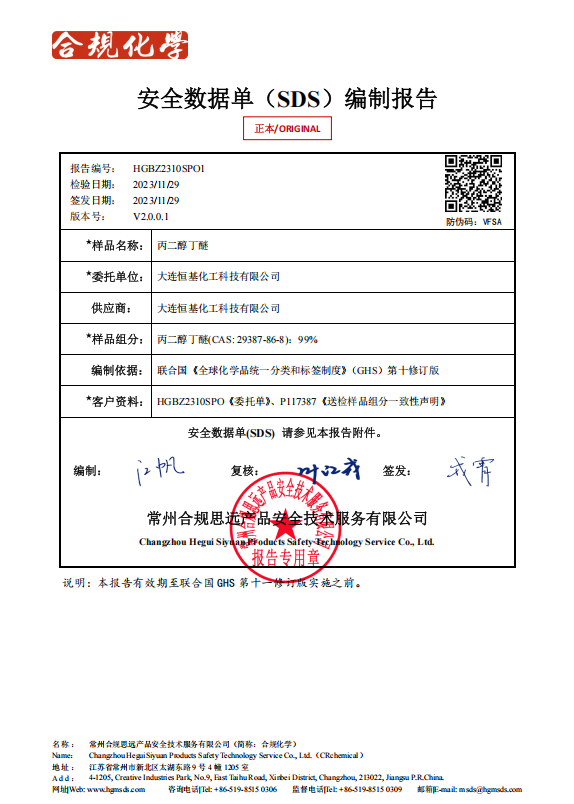
Its compliance file is already defined. The Safety Data Sheet compilation report for PNB is registered under certificate number HGBZ2310SPO1, compiled by Changzhou Hegui Siyuan Products Safety Technology Service Co., Ltd. (CRChemical), issued on 29 November 2023 and valid through 31 December 2026. It follows the United Nations Globally Harmonized System (GHS) Revision 10 and covers Propylene Glycol Butyl Ether at 99% purity. For European markets, REACH (EC No. 1907/2006) compliance applies to synthesis and industrial use.
Field evidence supports the coatings and cleaning positioning. A 20-ton PNB project for a coatings industry OEM client in China was completed within one year; the application of PNB for coating formulations resulted in stable coating performance and improved quality, with high purity, stable supply and excellent compatibility identified as the key aspects of the case.
DPNB — DI(PROPYLENE GLYCOL) BUTYL ETHER (CAS 35884-42-5)
DPNB is also supplied as a pure solvent, packed in 190 kg carbon steel drums — 10 kg heavier per drum than PNB. Its documented target applications are narrower and more specialised:
- High-performance coatings and inks.
- Precision cleaning and degreasing.
- Specialty chemicals.
That scope is the reason DPNB appears in precision cleaning and high-performance coating discussions rather than in general-purpose degreasing specifications. Because the grade is supplied against these specialised applications, buyers should request the grade-specific Safety Data Sheet and confirm REACH applicability for the intended market before qualification begins, rather than assuming the documentation set is identical to the PNB file.
The Four Axes That Decide It
A head-to-head decision between PNB and DPNB holds up only if the same four axes are applied to both candidates, in the same order.
- Application fit. Start from the documented application scope of each grade, not from generic descriptions of solvency. If the requirement is precision cleaning or a high-performance coating or ink system, DPNB is the grade to qualify. If it spans coatings, inks, cleaning agents and degreasers, or electronics and semiconductor work, PNB is the grade to qualify first.
- Compliance and documentation. Check the Safety Data Sheet, the GHS revision it follows, the purity scope it covers, the certificate number and the expiry date. For EU destinations, confirm REACH (EC No. 1907/2006) coverage for the grade in question.
- Packaging and handling. PNB arrives in 180 kg carbon steel drums; DPNB arrives in 190 kg carbon steel drums. That 10 kg difference per drum changes drum counts, manual handling planning and warehouse footprint calculations.
- Supplier capability and continuity. Confirm OEM and ODM support, packaging specification and private labelling flexibility, quality control method, minimum order quantity, standard lead time and after-sales technical support before locking a grade into a bill of materials.
Step-by-Step: Running a PNB vs DPNB Evaluation
The following sequence keeps the comparison evidence-based and avoids re-opening the decision after samples have been ordered.
Step 1 — Write the requirement in application language
Define the substrate, the process and the acceptance criteria in writing before contacting suppliers. “We need a glycol ether” is not a requirement; “coating and ink formulation with low-VOC targets” or “precision cleaning of greasy components with residue-free drying” is.
Step 2 — Map each candidate to its documented scope
Place PNB and DPNB side by side against that requirement using their stated application scopes. If only one grade is documented for the application, the comparison is already decided and the remaining work is supplier qualification.
Step 3 — Verify the compliance file before you sample
Request the Safety Data Sheet for the specific grade. For PNB, the reference file is certificate HGBZ2310SPO1, GHS Revision 10, covering 99% purity and valid through 31 December 2026. Confirm REACH (EC No. 1907/2006) applicability for the destination market. Documentation gaps discovered here cost days; documentation gaps discovered at the border cost weeks.
Step 4 — Compare packaging and handling mathematics
Convert the drum weights into operational numbers. A 180 kg PNB drum and a 190 kg DPNB drum produce different drum counts for the same target volume, different drum-handling plans and different residual volumes at the end of a batch. Confirm the minimum order quantity — 2 drums — against your trial volume before assuming a full-container commitment is required.
Step 5 — Qualify with a trial against your own criteria
Run the selected grade through your own formulation or cleaning line. Qualification data from your process is the only evidence that resolves the PNB versus DPNB question for your plant; supplier documentation narrows the field but does not replace a trial.
Step 6 — Lock the supply plan
Once the grade is confirmed, fix the commercial and service parameters: OEM or ODM packaging specification, private labelling, formulation support, 100% quality testing, standard lead time of 30–45 days, and the after-sales route (remote technical support, after-sales consultation and product usage guidance). Yunjian (Guangzhou) Import & Export Trade Co., Ltd., established in 2013, lists PNB, DPNB, TPNB, DPM, TPM and DPMA among its main products and supports OEM/ODM customisation across packaging specification, private labelling and formulation.
Use Cases: Where Each Grade Earns Its Place
Coatings and Inks
Both grades are documented for coatings and inks, with PNB covering coatings and inks generally and DPNB positioned for high-performance coatings and inks. The practical split is by performance target: standard coating and ink systems typically begin with PNB, while high-performance systems begin with DPNB. PNB’s coatings track record is documented through a 20-ton OEM project in China delivered over one year, where the application resulted in stable coating performance and improved quality.
Industrial Cleaning and Degreasing
PNB is documented for cleaning agents and degreasers. DPNB is positioned for precision cleaning and degreasing. Where the cleaning line requires a general degreasing step, PNB matches the documented scope; where the requirement is precision cleaning, DPNB matches it. PnB’s suitability for cleaning work is also supported by third-party analysis noting residue-free drying and high solvency for greases in electronics and precision cleaning.
Electronics and Semiconductor
PNB is documented for the electronics and semiconductor industry, and industry analysis identifies PnB as a preferred option in electronics and precision cleaning because of residue-free drying and grease solvency. Buyers with electronics cleaning requirements therefore have a documented starting point with PNB.
Specialty Chemicals
DPNB’s documented scope includes specialty chemicals, which is the application area where its narrower positioning is most relevant. Specialist formulations should be qualified against DPNB’s grade-specific documentation rather than against the PNB file.

PNB vs DPNB at a Glance
The table below compares only documented product facts. It is designed to be used as a screening tool before samples are requested.
| Comparison point | PNB — PROPYLENE GLYCOL BUTYL ETHER | DPNB — DI(PROPYLENE GLYCOL) BUTYL ETHER |
|---|---|---|
| CAS number | 15821-83-7 | 35884-42-5 |
| Product form | Pure solvent | Pure solvent |
| Documented application scope | Coatings and inks; cleaning agents and degreasers; electronics and semiconductor industry; other industrial applications | High-performance coatings and inks; precision cleaning and degreasing; specialty chemicals |
| Packaging | 180 kg/drum (180 L carbon steel drum) | 190 kg carbon steel drum |
| Documentation on file | Safety Data Sheet compilation report, certificate HGBZ2310SPO1, UN GHS Revision 10, purity 99%, issued 29 November 2023, valid through 31 December 2026 | Grade-specific Safety Data Sheet to be requested; confirm REACH (EC No. 1907/2006) applicability for the destination market |
| Typical evaluation starting point | Coatings, inks, cleaning agents and degreasers, electronics and semiconductor cleaning | High-performance coatings and inks, precision cleaning and degreasing, specialty chemicals |
| Supply parameters (Yunjian) | Minimum order quantity 2 drums; standard lead time 30–45 days; 100% quality testing; OEM/ODM with packaging specification, private labelling and formulation customisation; after-sales remote technical support and usage guidance | |
Note on market data: the global propylene glycol ether market was valued at approximately USD 2.03 billion in 2024 and is projected to reach USD 2.75 billion by 2034 (Fact.MR); China’s market is forecast at USD 606.5 million by 2034 (Fact.MR); the PnB segment is expected to grow at about 2% CAGR over 2024–2031 (Orion Market Reports).
Frequently Asked Questions
Are PNB and DPNB covered by the compliance documentation required for regulated markets?
PNB is covered by a Safety Data Sheet compilation report prepared under the United Nations Globally Harmonized System (GHS) Revision 10, certificate number HGBZ2310SPO1, compiled by Changzhou Hegui Siyuan Products Safety Technology Service Co., Ltd. (CRChemical), issued on 29 November 2023 and valid through 31 December 2026, with a scope of Propylene Glycol Butyl Ether (PNB) at 99% purity. In addition, propylene glycol butyl ether used in synthesis and industrial applications in European markets must comply with REACH (EC No. 1907/2006). For DPNB, buyers should request the grade-specific Safety Data Sheet and confirm REACH applicability for the intended market before qualification, because the two grades carry separate documentation files.
Can one supplier handle both PNB and DPNB, including OEM packaging and private labelling?
Yunjian (Guangzhou) Import & Export Trade Co., Ltd., established in 2013, lists both PNB and DPNB among its main products, alongside TPNB, DPM, TPM and DPMA. The company operates an OEM/ODM model that covers packaging specification, private labelling and formulation customisation, with 100% quality testing and export markets that include the EU and Southeast Asia. Sourcing both grades from a single supplier removes the need to run two separate qualification and documentation processes.
How should I compare the cost of PNB and DPNB when neither price is published?
Build the comparison on like-for-like units rather than on a headline number. PNB is packed at 180 kg per carbon steel drum and DPNB at 190 kg per carbon steel drum, a 10 kg difference per drum that changes drum counts, handling and inventory calculations for the same target volume. Minimum order quantity from Yunjian is 2 drums, with a standard lead time of 30–45 days. The relevant cost question is not which grade carries the lower list price, but which grade meets the documented application scope without forcing reformulation or requalification — a grade mismatch usually costs more than the price gap between the two solvents. Published pricing is not available for either grade; a project-specific quotation should be requested for the required volume and packaging.
Can I evaluate both grades before committing to a full order?
Evaluation should start with documents rather than drums: request the Safety Data Sheet for the specific grade and confirm the application scope against your requirement. The minimum order quantity of 2 drums makes a limited-volume trial practical, and Yunjian’s sales team can be contacted directly to discuss trial and sample arrangements for PNB, DPNB or both grades — email hx@yunjianchem.com or reach the team on WhatsApp at +86 181-489-99443 to start the qualification process.
What lead time and packaging should I plan for?
Standard lead time is 30–45 days. PNB is supplied in 180 kg/drum packaging (180 L carbon steel drum) and DPNB in 190 kg carbon steel drums, both as pure solvents in carbon steel drums. Minimum order quantity is 2 drums. After delivery, Yunjian provides remote technical support, after-sales consultation and product usage guidance — useful when a grade is being introduced into a formulation or cleaning line for the first time. To convert these parameters into a delivered plan for your volume, request the product brochure and a quotation from the sales team.
Conclusion: Choose by Documented Fit, Not by Reputation
The PNB versus DPNB decision resolves quickly once it is reframed. PNB (CAS 15821-83-7) is the grade documented for coatings and inks, cleaning agents and degreasers, and the electronics and semiconductor industry, supported by a Safety Data Sheet compilation report under GHS Revision 10 valid through 31 December 2026 and supplied in 180 kg carbon steel drums. DPNB (CAS 35884-42-5) is the grade positioned for high-performance coatings and inks, precision cleaning and degreasing, and specialty chemicals, supplied in 190 kg carbon steel drums.
Use the four axes — application fit, compliance documentation, packaging and handling, and supplier capability — in that order, and record the evidence for each before samples are ordered. Buyers who do this rarely need to revisit the grade decision; buyers who skip to price comparisons usually do.
Next step. Yunjian (Guangzhou) Import & Export Trade Co., Ltd. supplies both PNB and DPNB as pure solvents, with OEM/ODM packaging specification, private labelling and formulation customisation, 100% quality testing and a standard lead time of 30–45 days.
Download the product brochure: Yunjian product brochure
Website: www.YUNJIANMAOYI.COM
Email: hx@yunjianchem.com | Tel: +86 18318338888 | WhatsApp: +86 181-489-99443

Have Questions or Need More Details?
Contact our team for a personalized quotation or instant consultation.
Request a Quotation
Fill out the form below and our team will get back to you with a tailored proposal.
WhatsApp Direct Chat
Prefer to chat in real-time? Message us on WhatsApp for instant assistance & quick answers.
- Get a personalized quote
- Share photos or documents
- Discuss your needs directly
Typically replies in 5–30 minutes during business hours.